
Welcome to my next blog post based on our season 6 ‘Ask Angelika’ shows with practical or useful sentences you might hear or use yourself in certain scenarios.
Today we’re covering German sentences you might need or hear while spotting birds in Germany.
This page contains affiliate links to Amazon. It means I’ll get a few pence if you buy anything – at no extra cost to you.
Hast du den Vogel da gehört? Das war kein gewöhnlicher Spatz.
Did you hear that bird? That wasn’t an ordinary sparrow.
Das war bestimmt ein Vogel, den man nicht jeden Tag sieht.
That must have been a bird you don’t see every day.
Ich habe so einen Vogel noch nie gesehen.
I’ve never seen a bird like that before.
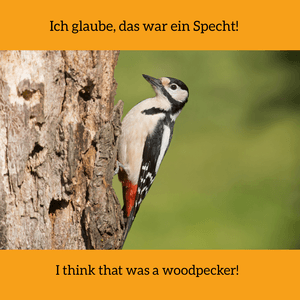
Ich glaube, das war ein Specht!
I think that was a woodpecker!
Das könnte ein Bussard sein – ein Greifvogel.
That might be a buzzard – a bird of prey.

Siehst du den Rotmilan da oben? Der hat einen gegabelten Schwanz.
Can you see the red kite up there? It has a forked tail.

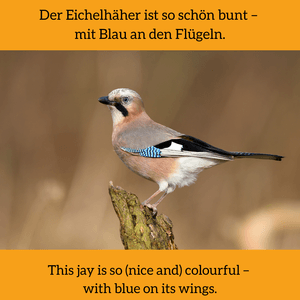
Der Eichelhäher ist so schön bunt – mit Blau an den Flügeln.
This jay is so (nice and) colourful – with blue on its wings.
Könnte das ein Zugvogel sein?
Could that be a migratory bird?
Ja, aber es ist kein Kranich, sondern ein Storch.
Yes, but it’s not a crane, it’s a stork.

Here’s the video where Steven gets to practise saying and translating the sentences:
What can you do with these sentences to remember them?
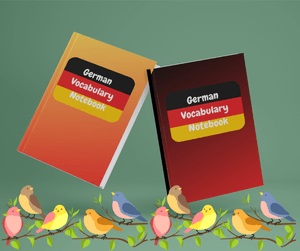
You can bookmark this post or make a vocabulary list with them. You can do that with any paper or electronic notebook. Or you could buy my notebook which I designed specially for German vocab learners. It has space for vocabulary lists and sentences. You can even choose one of two colours 😉
Each notebook has space for 25 topics and each topic has 4 pages, 1 is blank, 1 is for your vocabulary list and 2 are for sentences. So you could copy the sentences from this post and add any individual words to the vocab list (like: der Specht – woodpecker). There is also lots of space for you to add any of your own sentences.